
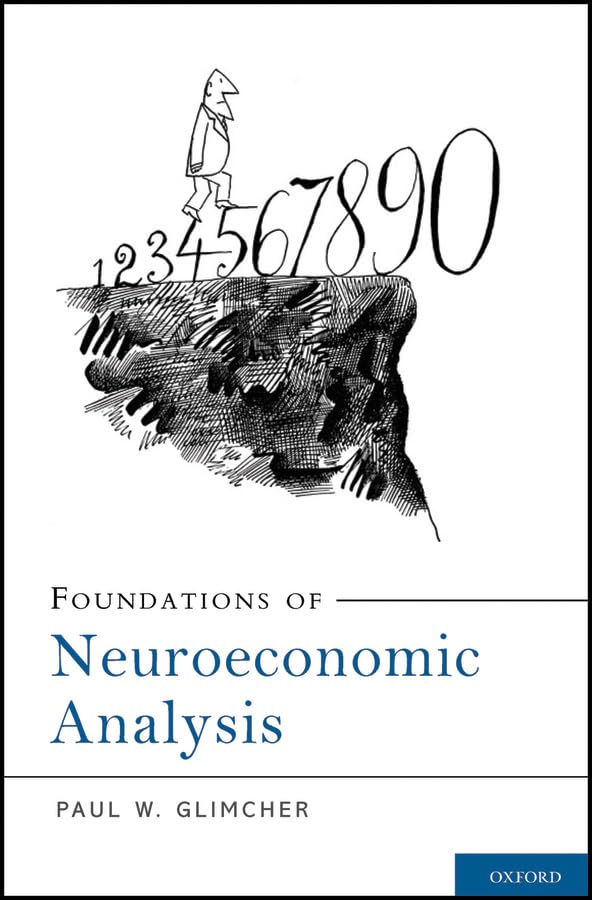
Foundations of Neuroeconomic Analysis
Product details
| Management number | 231968896 | Release Date | 2026/06/18 | List Price | US$24.08 | Model Number | 231968896 | ||
|---|---|---|---|---|---|---|---|---|---|
| Category | |||||||||
A new academic field, neuroeconomics, has emerged at the border of the social and natural sciences. In Foundations of Neuroeconomic Analysis, Paul Glimcher argues that a meaningful interdisciplinary synthesis of the study of human and animal choice is not only desirable, but also well underway, and so it is time to formally develop a foundational approach for the field. He does so by laying the philosophical and empirical groundwork and integrating the theory of choice and valuation with the relevant physical constraints and mechanisms.While there has been an intense debate about the value and prospects of neuroeconomics, Glimcher argues that existing data from neuroeconomics' three parent fields, neuroscience, psychology and economics, already specify the basic features of the primate choice mechanism at all three levels of analysis. His central argument is that combining these three disciplines gives us enough insight to define many of the fundamental features of decision making that have previously eluded scholars working within each individual field.With this in mind, Glimcher provides a comprehensive overview of the neuroscience, psychology, and economics of choice behavior, which will help readers from many disciplines to grasp the rich interconnections between these fields and see how their data and theory can interact to produce new insights, constraints, and questions. The book is divided into four main sections that address key barriers to interdisciplinary cohesion. The first section defines the central philosophical issues that neuroeconomics must engage. The theory of knowledge already tells us much about how different disciplines interact, and in this section, Glimcher reviews those constraints and lays a philosophical foundation for future neuroeconomic discourse. This section concludes with both a defense of neoclassical economics and a spirited attack on Milton Friedman's insistence that economics must not be constrained by the study of mechanism. Glimcher argues instead for the development of "hard-economic theories", which postulate that choosers behave the way they do because of the underlying representations that occur in their brains.The second section describes what is known about the primate choice mechanism-the physical structures in our brains that actively select among the options available to the chooser. By reviewing and integrating economic theory of choice, neurobiological studies of the frontal and parietal cortices, and psychological models of selection, Glimcher creates an interdisciplinary structure for understanding how we choose. This interdisciplinary synthesis leads to several novel insights into the causes of human irrational behavior and recasts many of these so-called irrationalities as neurobiological optimizations in the face of physical constraints.The third section describes the neural circuits for valuation-the physical mechanisms by which we learn, store, and represent the values of the many options from which we choose. In this section, Glimcher combines studies from computer science and neuroscience with representational frameworks from economics to provide novel assessments of both the strengths and weaknesses of modern economic theory. The section ends with a discussion of behavioral neuroeconomics and the ultimate limits of the neoclassical economic program.The book concludes with a description of a new model for human choice behavior that harvests constraints from each of neuroeconomics' parent disciplines and encapsulates the key insights from current research, as well as a review of the major accomplishments and opportunities that await the new field of neuroeconomics. Read more
| ASIN | B00HNSNAJ0 |
|---|---|
| XRay | Not Enabled |
| Format | Print Replica |
| ISBN13 | 978-0199780631 |
| Edition | Illustrated |
| Language | English |
| File size | 12.6 MB |
| Page Flip | Not Enabled |
| Publisher | Oxford University Press |
| Word Wise | Not Enabled |
| Print length | 467 pages |
| Accessibility | Learn more |
| Publication date | November 24, 2010 |
| Enhanced typesetting | Not Enabled |
Bestseller ranking
Historical




Customers who viewed this product also viewed
Neuroscience



Correction of product information
If you notice any omissions or errors in the product information on this page, please use the correction request form below.
Correction Request Form